
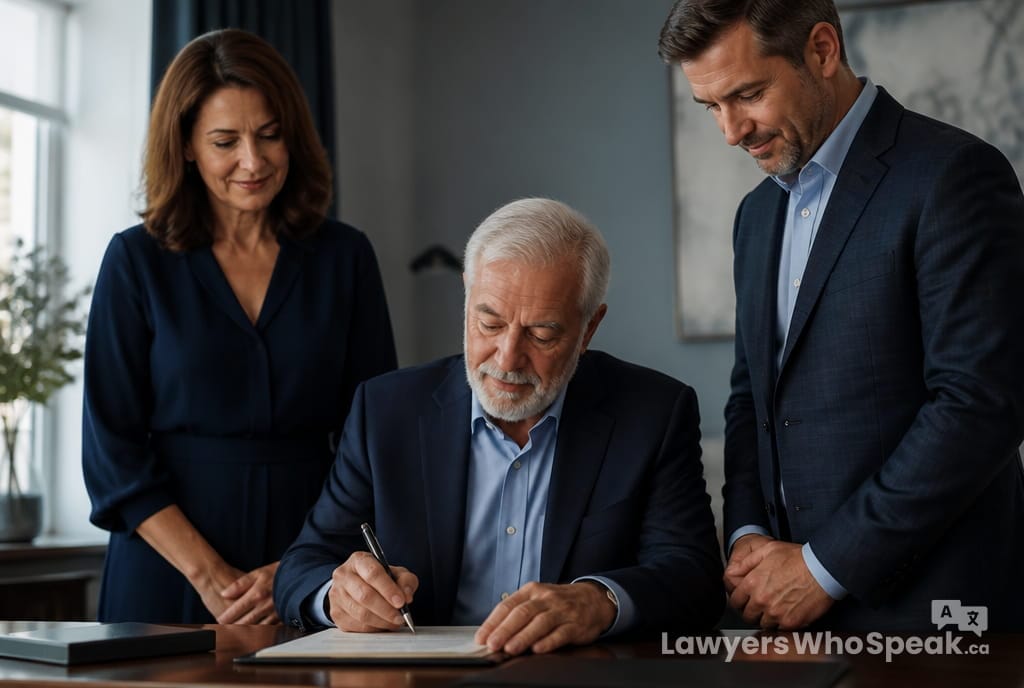
Making a will is one of the most important things you can do for the people you love. A properly drafted will gives you control over how your assets are distributed after your death, who looks after any children under the age of majority, and who handles the administration of your estate. Without a valid will, the distribution of your assets is determined by Ontario law rather than by your wishes, which often leads to outcomes you would not have chosen for your family.
Despite this, surveys consistently find that more than half of Canadian adults do not have a will. Many people put it off because the subject is uncomfortable, because they think they do not own enough to need one, or because they are unsure where to begin. The truth is that almost every adult in Ontario should have a will, and creating one is more straightforward than most people expect.
This guide explains how to make a valid will in Ontario, what your will should include, the costs involved, and how to find an estate lawyer in the GTA who can prepare your will in your first language.
Meet Our Wills & Estates Lawyers




Why You Need a Will in Ontario
A will is the only way to clearly direct what happens to your property after you die. Without one, your estate is distributed according to the rules of the Succession Law Reform Act, which may produce a result very different from what you would have wanted.
What a Will Lets You Do
- Name an executor (the person who will administer your estate)
- Decide who inherits your property and in what proportions
- Name a guardian for any minor children
- Make specific gifts of particular items (jewellery, family heirlooms, vehicles, etc.)
- Create trusts for beneficiaries who are minors or who you want to provide for over time
- Make charitable gifts or set aside funds for organizations you support
- Reduce conflict and uncertainty among family members during a difficult time
- Plan for the tax implications of your estate
What Happens if You Die Without a Will in Ontario
Dying without a will is called dying ‘intestate’. When that happens, your estate is distributed according to Part II of Ontario’s Succession Law Reform Act, which sets out a specific order of priority:
| Family Situation at Death | How the Estate Is Distributed |
| Spouse, no children | The entire estate goes to the spouse. |
| Spouse and one child | Spouse receives a ‘preferential share’ (currently $350,000) plus one-half of the remainder. The child receives the other half. |
| Spouse and two or more children | Spouse receives the preferential share plus one-third of the remainder. The children share the remaining two-thirds equally. |
| No spouse, but children | The estate is divided equally among the children. |
| No spouse and no children | Estate goes to parents, then to siblings, then to nieces and nephews, then to more distant relatives. |
| No relatives at all | Estate ultimately becomes property of the Ontario government. |
Several important consequences follow from intestacy that surprise many families.
Important consequences of dying without a will:
- Common-law partners do not inherit anything under Ontario intestacy law. This is one of the most common and damaging consequences of not having a will. A common-law partner may have a separate claim for support, but they do not automatically inherit.
- Step-children and step-grandchildren are not treated as children under intestacy. Without a will naming them, they receive nothing.
- You cannot name a guardian for minor children without a will. A court will appoint one, which may not be the person you would have chosen.
- The administrator of an intestate estate must post a bond and follow strict court procedures, often delaying distribution to beneficiaries by months.
- Specific items of sentimental value cannot be directed to specific people, leading to family conflict.

Legal Requirements for a Valid Will in Ontario
Ontario has specific legal requirements for a will to be valid. A document that does not meet these requirements may be challenged or rejected entirely by the court when the estate is being administered.
The Three Core Requirements
- Age and capacity: The testator (the person making the will) must be at least 18 years old and have testamentary capacity, meaning they understand what they are doing, what they own, and who their natural beneficiaries are.
- Written form: The will must be in writing. Oral statements about how you want your assets distributed have no legal effect in Ontario, regardless of who heard them.
- Proper signing and witnessing: For a standard will, the testator must sign in the presence of two witnesses who are present at the same time, and both witnesses must sign in the presence of the testator. Witnesses must be at least 18 and must not be beneficiaries under the will or married to beneficiaries (because their gifts will be void if they witness).
Holographic Wills
Ontario also recognizes ‘holographic wills’, which are wills written entirely in the testator’s own handwriting and signed by the testator. Holographic wills do not require witnesses to be valid. They are sometimes used in emergencies or by people who cannot access a lawyer. However, holographic wills are vulnerable to challenge because of ambiguous wording, incomplete instructions, and questions about the testator’s mental state at the time of writing. A holographic will is far better than no will, but a properly drafted formal will is strongly preferable for almost everyone.
Wills Made Outside Ontario
A will made outside Ontario can still be valid in Ontario if it was made in compliance with the laws of the place where it was made, the place where the testator was habitually resident, or the place of the testator’s nationality at the time. This is particularly relevant for newcomers to Canada who may have made wills in their country of origin. However, foreign wills can create administrative complications, and updating your will to comply with Ontario law after you settle in the province is generally recommended.
What Your Will Should Include
Every will is different because every family and estate is different. However, there are certain elements that every well-drafted Ontario will should address.
Naming an Executor
The executor (also called the ‘estate trustee’) is the person responsible for administering your estate after your death. This is a significant responsibility that involves locating your assets, paying your debts and taxes, distributing what remains to your beneficiaries, and filing accounts with the court if required. Your executor should be someone you trust, who is organized and capable of dealing with paperwork and family communication, and who is willing to take on the role.
You can name an individual, multiple individuals (acting jointly), a trust company, or a combination. Naming an alternate executor is essential in case your first choice is unable or unwilling to serve when the time comes. Executors are entitled to compensation for their work, typically calculated as a percentage of the estate.
Identifying Beneficiaries
Be specific about who inherits what. Identify beneficiaries by full legal name and relationship to you. Consider what happens if a beneficiary dies before you do, particularly for major gifts. Most wills include a ‘survivorship’ clause requiring beneficiaries to survive you by a specified period (typically 30 days) before they can inherit, to avoid the complication of an inheritance passing immediately through their own estate.
Guardianship of Minor Children
If you have children under the age of 18, your will is the place to name a guardian who would care for them in the event you and your spouse both died. The court has the final say on who is appointed guardian, but courts give significant weight to the parents’ stated wishes in a will. Discuss your choice with the person you intend to name to confirm they are willing.
Specific Gifts and the Residue
Specific gifts are particular items or amounts of money left to particular people. The residue of the estate is everything that remains after specific gifts, debts, taxes, and expenses are paid. The residue is usually the largest portion of an estate and goes to your residuary beneficiaries (often your spouse first, then children, in proportions you choose).
Trusts for Minor Beneficiaries
If you leave money to minor children, the law requires that those funds be held in trust until the child reaches the age of majority (18 in Ontario). Your will should set out the terms of any trust for minors, including who serves as trustee, when the trust funds can be distributed, and what they can be used for. Many parents extend the trust beyond age 18 (commonly to 21 or 25), recognizing that most young adults are not ready to manage a significant inheritance immediately.
Should You Use a Lawyer or a Will Kit?
Online will kits and template-based services are widely advertised and significantly cheaper than working with a lawyer. They are also responsible for a meaningful share of the estate problems that lawyers and courts deal with.
A will is one part of a complete estate plan. The essential companion documents are a Continuing Power of Attorney for Property and a Power of Attorney for Personal Care. See our guide on power of attorney in Ontario for how these documents work and why you need all three.
For an explanation of what happens after death, including the executor’s duties and the probate process, see our guide on estate administration and probate in Ontario.
Newcomers to Canada sometimes ask whether a notary can prepare a will instead of a lawyer. In Ontario, wills are prepared by lawyers, not by notaries. If you are accustomed to a notary preparing wills (as is common in Quebec, British Columbia, and many other countries), this distinction is important to understand before you begin. See our guide on do I need a lawyer or a notary in Canada for the full explanation.
When a Will Kit May Be Sufficient
For an extremely simple estate, a will kit may produce a valid document. The hallmark of such an estate: one common-law or married spouse, no children from previous relationships, modest assets, no business interests, no real estate outside Ontario, and an obvious primary beneficiary. Even in this case, a will kit will not provide tax planning advice, will not consider potential family law claims, and will not catch errors in execution that could invalidate the document.
When You Should Use a Lawyer
A lawyer’s involvement is genuinely important in any of the following situations. If you are unsure whether your circumstances warrant a lawyer, our guide on what to expect at your first legal consultation explains how a brief paid or free consultation can help you decide:
- You have children from a previous relationship or a blended family
- You own real estate, particularly multiple properties or property outside Ontario
- You own a business or shares in a private corporation
- You have significant investment or registered accounts (RRSPs, RRIFs, TFSAs)
- You want to set up trusts for any beneficiaries
- You want to disinherit or limit gifts to anyone who would normally inherit
- You have a beneficiary with a disability or who is receiving government benefits
- You have assets or family members in other countries
- You anticipate the will may be contested
- Your total estate is significant enough that tax planning matters (generally over $500,000 to $1 million)
What a Will Costs in Ontario
Lawyer-drafted wills in Ontario typically range from $400 to $1,500 for a basic will, and $800 to $3,000 for couples having mirror wills prepared together. More complex estate planning involving trusts, business interests, or multiple jurisdictions can cost more. Most estate lawyers also include powers of attorney for property and personal care in their will packages. Before any work begins, make sure you have a clear written retainer agreement that sets out exactly what is included and how you will be charged. For a detailed breakdown of legal fees generally, see our guide to how much a lawyer costs in Ontario. If you are still deciding whether you need a lawyer at all, our guide on how to get legal advice in Ontario covers free consultation options available to Ontario residents.
Powers of Attorney: The Often-Overlooked Companion Documents
A will only takes effect when you die. While you are alive but unable to make decisions for yourself, a will does nothing. This is where powers of attorney come in. Most Ontario estate lawyers prepare these documents at the same time as a will, and they are arguably as important.
Power of Attorney for Property
A Power of Attorney for Property authorizes a person you trust to manage your financial affairs if you become unable to do so yourself. This includes paying bills, managing investments, dealing with banks, and handling real estate if necessary. Without one, your family would need to apply to court to be appointed your guardian of property, an expensive and time-consuming process.
Power of Attorney for Personal Care
A Power of Attorney for Personal Care authorizes someone to make decisions about your medical care, living arrangements, nutrition, hygiene, and safety if you become incapable of making those decisions yourself. You can include specific instructions about end-of-life care, religious considerations, and other preferences. Without one, healthcare providers may need to follow Ontario’s substitute decision-maker hierarchy, which may not produce the result you would have chosen.
Updating Your Will: When and How
Your will is a snapshot of your wishes and your circumstances at the time you make it. Both can change. Reviewing your will every few years and after any major life event is essential.
Life Events That Should Trigger a Will Review
- Marriage (note: as of 2022 in Ontario, marriage no longer automatically revokes a will, but you should still update)
- Divorce or separation (any gift to a former spouse is automatically revoked, but other terms remain). For questions about how separation affects family arrangements generally, see our family law practice area.
- The birth or adoption of a child or grandchild
- The death of a beneficiary or executor named in your will
- Significant changes in your assets (sale of a business, inheritance, purchase of real estate)
- A move to another province or country
- Changes in tax laws or estate laws that materially affect your plan
How to Update a Will
There are two ways to change a will. A ‘codicil’ is a separate document that amends specific provisions of an existing will. Codicils must be executed with the same formalities as the original will (two witnesses, etc.). For significant changes, however, most lawyers recommend making a new will rather than relying on a codicil, both for clarity and to avoid confusion about which document is operative.

Estate Planning for Multilingual and Newcomer Families in the GTA
Estate planning touches on deeply personal subjects: family relationships, religious traditions, the legacy you want to leave, and how you want to provide for loved ones in different countries. For multilingual and newcomer families in the GTA, finding an estate lawyer who speaks your language is often the practical difference between a will that truly reflects your wishes and one that approximates them.
Cross-Border Estate Issues
Many GTA residents have property or family members in other countries. This raises several considerations. Property held in another country is generally governed by that country’s succession laws, not Ontario’s. You may need a separate will dealing with foreign property, or a single will carefully drafted to address multiple jurisdictions. Sponsoring family members for immigration, or receiving inheritances from abroad, can create tax consequences that should be planned for. An estate lawyer experienced with cross-border situations can help you structure your affairs to avoid conflicts and tax inefficiencies.
Religious and Cultural Considerations
Ontario law generally allows you to distribute your estate however you wish, subject to certain claims (such as those of a spouse or dependants). This means you can structure your will to align with religious principles such as Islamic faraid inheritance rules, Hindu or Sikh family traditions, or church-based commitments, while still complying with Ontario law. An estate lawyer who understands both Ontario law and your religious or cultural tradition can prepare a will that respects both.
Why a Bilingual Estate Lawyer Matters
Wills and powers of attorney use precise legal language that has specific consequences. Conversations about your wishes, your family, and your assets are sensitive and detailed. Discussing these matters in your first language with a wills and estates lawyer ensures that your will truly reflects what you intend, and that you understand exactly what each clause means. For practical guidance on the search process, our guide on how to find a multilingual lawyer in Toronto is a good starting point. Lawyers Who Speak connects GTA families with verified, Law Society of Ontario-licensed estate lawyers who speak their language.
Frequently Asked Questions
How much does it cost to make a will in Ontario?
A simple lawyer-drafted will in Ontario typically costs between $400 and $1,500, depending on the lawyer’s experience, the complexity of your situation, and your location. Couples having ‘mirror wills’ (where each leaves their estate to the other) often pay $800 to $2,000 for both wills together. Most estate lawyers also include powers of attorney for property and personal care in their fee, sometimes as a package of $1,000 to $2,500 for the complete set of documents. More complex estates involving trusts, business interests, or multiple jurisdictions cost more. Online will kits cost between $40 and $200 but provide no legal advice and can lead to problems that cost the estate far more to resolve.
Can I write my own will in Ontario?
Yes. Ontario recognizes ‘holographic wills’, which are wills written entirely in the testator’s own handwriting and signed by the testator. Holographic wills do not need witnesses. However, holographic wills are vulnerable to challenge because of ambiguous wording, incomplete instructions, or questions about the testator’s mental state. They are appropriate only as an emergency measure (for example, if you cannot access a lawyer before a high-risk activity). For almost everyone, a properly drafted formal will is significantly better protection for your family.
Does marriage or divorce affect my will in Ontario?
Both can affect your will. Since January 1, 2022, marriage no longer automatically revokes a previously made will in Ontario. However, you should review and update your will after marriage to reflect your new circumstances. Divorce in Ontario does not revoke a will, but any gift in the will to a former spouse is treated as if the former spouse died before the testator. Other terms in the will continue to apply. Separation (without divorce) does not have the same effect, which is one reason updating your will after a separation is important. For separation and divorce matters generally, see our family law practice area. A common-law relationship beginning or ending has no automatic effect on a will, but common-law partners do not inherit on intestacy.
Where should I keep my will after it is made?
Your original signed will should be kept in a safe and accessible location. Common choices include your lawyer’s office (most estate lawyers will store wills for clients at no additional charge), a safety deposit box (with careful consideration since access after death can be cumbersome), or a fireproof safe at home. Your executor must know where to find the original. Photocopies are not sufficient for probate; the original is required. You can also register your will with the Ontario government’s Estate Registry through Wills.org or have your lawyer maintain a record of its location.
What is probate, and will my estate need to go through it?
Probate (formally called a ‘Certificate of Appointment of Estate Trustee with a Will’) is a court process that confirms the validity of a will and the executor’s authority to act. Many financial institutions and the Land Registry Office require probate before they will release funds or transfer title. Probate costs in Ontario are based on the value of the estate at death, approximately 1.5% of estate value over $50,000 (the Estate Administration Tax). Not all estates require probate. Estates consisting entirely of jointly held property, registered investments with named beneficiaries, and life insurance with named beneficiaries may pass outside of the estate and avoid probate. An estate lawyer can advise on strategies to reduce the probate burden, including using multiple wills for business interests or careful beneficiary designations.
Find an Estate Lawyer in the GTA Who Speaks Your Language
Making a will is one of the most important and most personal things you can do. Having an estate lawyer who can discuss your wishes, your family, and your assets with you in your first language ensures that your will truly reflects what you intend to leave behind.
Lawyers Who Speak connects GTA families with verified, Law Society of Ontario-licensed estate lawyers who speak their language. Search by language and practice area to find a qualified estate lawyer near you.
Disclaimer: This article is for informational purposes only and does not constitute legal advice. Estate planning situations are fact-specific and the law can change. If you are planning to make a will, update an existing will, or have questions about estate planning in Ontario, please consult a qualified wills and estates lawyer licensed in Ontario for advice specific to your situation.