
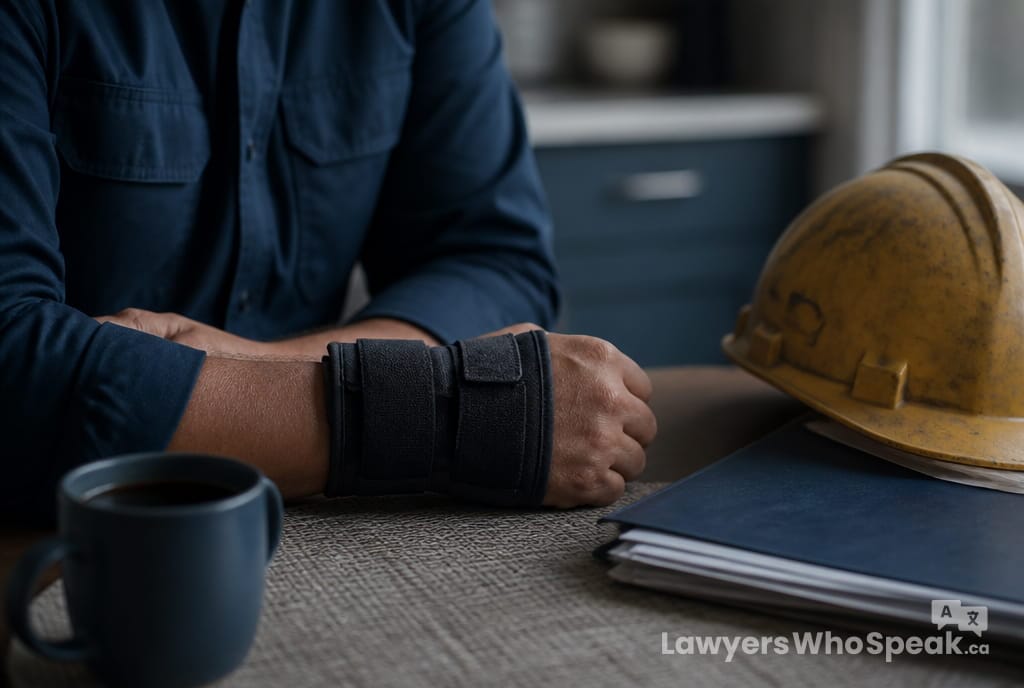
A workplace injury changes more than your body. It can cut off your income, disrupt your family, and leave you wondering whether your job is still there when you recover. In Ontario, most workers who are hurt or made ill by their work are protected by a government insurance system rather than by a lawsuit, and understanding how that system works, and how to use it correctly, can make a large difference to the support you receive.
That system is run by the Workplace Safety and Insurance Board, known as the WSIB. It pays for treatment, replaces part of lost income, helps injured workers return to work, and compensates for permanent impairment. It is also a system with strict reporting deadlines, detailed rules about who is covered, and an appeals process that many people only discover after a claim has been denied or reduced.
This guide explains how WSIB claims work in Ontario: who is covered, how and when to file, the benefits available, the return to work process, what to do if a claim is denied, and what employers must do. It is a companion to our guides on personal injury in Ontario and motor vehicle accident claims in Ontario, which cover injuries outside the workers’ compensation system. It also explains how to find a personal injury lawyer in the GTA who speaks your language.
Meet Our Personal Injury Lawyers









How Workers’ Compensation Works
Ontario’s workers’ compensation system is built on a trade-off. Workers covered by the system receive no-fault benefits, meaning you do not have to prove your employer did anything wrong in order to be compensated. In exchange, covered workers generally give up the right to sue their employer, or other covered employers and workers, for a workplace injury. Employers fund the system through premiums, and the WSIB decides claims and pays benefits.
This is very different from a personal injury lawsuit. There is no trial in front of a judge, no award for pain and suffering in the usual sense, and no need to prove fault. The system is administrative: your claim is decided by WSIB staff, and if you disagree with a decision, you challenge it through a defined internal appeals process and then a separate independent tribunal.
This guide covers compensation after an injury or illness. It does not cover workplace health and safety enforcement, such as inspections or a worker’s right to refuse unsafe work, which fall under a separate law.
Who Is Covered
Coverage depends mainly on the industry your employer operates in, not on whether your employer chose to register. Most employers in industries such as construction, manufacturing, mining, transportation, healthcare, and many service sectors are required to be covered. Some industries, including many professional and office-based businesses, banks, and some retail operations, are not covered by the mandatory system, though an employer may choose to register voluntarily. Federal government employees, and workers in federally regulated industries such as banking and interprovincial transportation, are generally covered by separate arrangements.
Sole Proprietors, Partners, and Executive Officers
Independent operators, sole proprietors, partners, and executive officers of a corporation are generally not covered unless they apply for optional coverage. This matters for many small business owners in the GTA, who may assume they are protected and discover otherwise only after an injury.
Employees Called Contractors
Calling a worker an independent contractor does not decide whether WSIB treats the person as a worker. The WSIB looks at the real working relationship, including who controls the work, who provides the tools, and how the person is paid. A worker who has been labelled a contractor but functions as an employee may still be covered, and the employer may owe premiums. Employers should understand this distinction when structuring their workforce; see our guide on starting a business in Ontario for how the employee versus contractor question affects other obligations as well.
Temporary Agency Workers, Part-Time Workers, and Newcomers
Part-time, casual, and temporary agency workers can be covered like any other worker, depending on the employer’s industry. Your immigration status does not by itself prevent you from filing a claim, and the system does not require a particular citizenship. Some newcomers hesitate to report an injury out of fear of losing a job or affecting their status, which is discussed further below.
What Injuries and Illnesses Are Covered
To be compensated, an injury or illness generally must arise out of and in the course of your employment. This is a broad concept that covers many situations beyond a dramatic accident.
- Traumatic injuries: falls, cuts, fractures, burns, crush injuries, and similar accidents at work.
- Gradual onset injuries: repetitive strain, back injuries from lifting over time, and similar conditions that develop from the work itself.
- Occupational diseases: illnesses caused by workplace exposures, such as hearing loss from noise, lung disease from dust or fibres, and certain cancers linked to specific work. These claims often involve long delays between exposure and diagnosis.
- Mental stress: the WSIB recognizes traumatic mental stress and, since 2018, chronic mental stress arising from work. Ontario law also presumes post-traumatic stress disorder is work-related for certain occupations, such as first responders, making those claims easier to establish.
- Aggravation of a pre-existing condition: if work makes an existing condition worse, the aggravation may be compensable even though the underlying condition was not caused by work.
An ordinary commute to and from work is generally not covered, though exceptions exist where you are travelling as part of your job duties or in transportation the employer provides.

Reporting and Filing a Claim
Timing and documentation matter more in a WSIB claim than most people expect. A late or unclear report can make a legitimate claim harder to establish.
| Step | Who Acts | Typical Timing |
| Tell your employer about the injury or illness | Worker | As soon as possible, ideally the same day |
| Get health care and tell the practitioner it is work related | Worker | Immediately |
| Report the injury to the WSIB | Employer | Generally within 3 days of learning of an injury that needs health care beyond first aid or causes lost time or reduced pay |
| File your own claim | Worker | Generally within 6 months of the accident, or of learning you have a work-related disease |
| Object to a WSIB decision | Worker or employer | Generally 6 months, but as short as 30 days for some return to work and re-employment decisions |
| Appeal to the Workplace Safety and Insurance Appeals Tribunal | Worker or employer | Generally 6 months after a final WSIB decision |
These are general time limits, and the WSIB can sometimes extend them in exceptional circumstances, but you should never count on that. The decision letter you receive normally states the deadline that applies to that specific decision. Read it carefully and act well before the date.
Practical Steps After a Workplace Injury
- Report the injury to your employer in writing if possible, and keep a copy.
- Tell every healthcare provider that the injury or illness is work related, and describe the cause consistently.
- Keep a record of dates, symptoms, treatment, missed work, and conversations with your employer and the WSIB.
- Collect names of any witnesses and photographs of the scene or equipment where possible.
- Do not wait for your employer to file for you. You are entitled to file your own claim.
Careful record keeping helps at every later stage. Our guide on how to prepare for a legal case explains how to organize documents and timelines, which is directly useful if a claim becomes contested.
What Benefits Does WSIB Provide
| Benefit | What It Covers |
| Health care benefits | Treatment and related costs for the work injury, such as physiotherapy, medication, and assistive devices, paid at approved rates |
| Loss of earnings benefits | Replaces a portion of your lost income while you cannot work or can only work reduced hours. Generally 85 percent of your net average earnings, up to a yearly maximum |
| Non-economic loss benefit | A payment for permanent impairment, based on a medical assessment of the degree of impairment |
| Future economic loss benefit | Ongoing compensation for some workers with permanent impairment whose earning capacity is reduced |
| Labour market re-entry | Assessment, planning, and retraining support when you cannot return to your old work |
| Survivor benefits | Support for the family of a worker who dies from a work-related injury or illness |
Benefits can interact with other income sources, including employment insurance, disability insurance through work, and Canada Pension Plan disability benefits. Reviewing how these fit together before accepting or relying on any one benefit is worthwhile, since the rules differ and some payments can be offset against others.

Return to Work and the Duty to Re-employ
The WSIB system is built around getting injured workers back to suitable work as soon as it is safe. Both the worker and the employer have obligations in that process.
- The worker is expected to cooperate in return to work planning, stay in contact with the employer, and follow medical advice.
- The employer is expected to cooperate in early and safe return to work, which can include modified duties or adjusted hours.
- Larger employers, generally those with 20 or more workers, have a statutory duty to re-employ an injured worker who had at least one year of service, for a limited period, once the worker is able to perform the essential duties of the job or suitable work.
Return to work issues often overlap with the employer’s obligations under the Human Rights Code. If a work injury leaves you with a lasting disability, the employer’s duty to accommodate may apply in addition to the WSIB rules; see our guide on workplace discrimination and human rights in Ontario for how accommodation works and how a human rights claim differs from a WSIB claim.
Your Employer Cannot Punish You for Claiming
Ontario law prohibits an employer from firing, disciplining, threatening, or otherwise penalizing a worker for filing a WSIB claim or for pursuing benefits. If you believe you were let go or treated worse because you were injured or because you made a claim, you may have remedies through the WSIB process, a human rights claim, a wrongful dismissal claim, or a combination. Which route fits depends on the facts, so legal advice early matters. See our guide on wrongful dismissal in Ontario for how termination entitlements work.
When a Claim Is Denied or Benefits Are Cut
Many legitimate claims are denied at first, and many benefits are reduced or ended at a later stage. Common reasons include a dispute about whether the injury was work related, a late report, gaps or inconsistencies in the medical record, an argument that a pre-existing condition rather than work caused the problem, a finding that you have recovered or can return to work, or a disagreement about the amount of benefits.
A denial is not the end of the matter. The decision letter explains the reasons and the deadline for objecting, and strong evidence, especially consistent medical documentation and a clear account of how the work caused or contributed to the problem, often changes the result at the appeal stage.

The Appeals Process
There are two main levels of appeal, and the order matters.
Step 1: Objection Within the WSIB
You first file a notice of objection with the WSIB, explaining why you disagree with the decision. The WSIB may reconsider at the operating level. If the disagreement continues, the matter goes to the WSIB’s Appeals Services Division, where an Appeals Resolution Officer reviews the file and often holds a hearing, which can be conducted in writing or by video or phone.
Step 2: The Workplace Safety and Insurance Appeals Tribunal
If you are still dissatisfied after the Appeals Services Division decision, you can appeal to the Workplace Safety and Insurance Appeals Tribunal, known as the WSIAT. This is an independent tribunal, separate from the WSIB. It conducts a fresh review of the evidence and the law and can overturn WSIB decisions. Appeals to the tribunal have their own deadlines and procedures, and the process can take considerable time.
Because each stage builds on the record created at the earlier one, the quality of the evidence and arguments at the first objection matters a great deal. Starting with good representation, rather than seeking help only at the tribunal, usually improves the chances of success.
Can You Sue After a Workplace Injury
For most covered workers, the answer is no as far as the employer and other covered employers and workers are concerned. This is the other side of the no-fault trade-off. Whether your right to sue is actually barred in a particular situation is itself a legal question, and the WSIAT can decide it.
There are situations where a civil claim may still be possible, most commonly against a party who is not covered by the system, such as a driver who caused a collision involving a worker, or the manufacturer of a defective piece of equipment. In those cases, you may face a choice between receiving WSIB benefits and suing, and the interaction between the two can be complex. See our guides on personal injury in Ontario and motor vehicle accident claims in Ontario for how those claims work, and speak with a lawyer before making any election, since a choice made without advice can be difficult to reverse.
For Employers: Your Obligations
Employers have their own significant responsibilities under the system, and failing to meet them can lead to penalties, higher premiums, and disputes.
- Register with the WSIB and pay premiums if your business is in a covered industry.
- Report workplace injuries and illnesses to the WSIB within the required time.
- Cooperate in early and safe return to work, including offering suitable modified work where possible.
- Meet the duty to re-employ where it applies.
- Do not penalize a worker for making a claim.
- Respond to WSIB requests for information promptly and accurately, since the employer’s account often shapes how a claim is decided.
Employers also have the right to participate in claims and to object to decisions, since claims costs can affect premiums. Small employers in particular benefit from understanding these rules before a claim arises.
Newcomers and Workers With Precarious Status
Newcomers and workers in precarious jobs are among the most likely to be injured and among the least likely to claim. Fear of losing the job, uncertainty about immigration consequences, language barriers, and pressure from an employer to treat the injury informally all contribute. But filing a claim is a legal right, and the law prohibits retaliation.
If you hold an employer-specific work permit, your status may depend on keeping the job, which makes employer pressure especially hard to resist. See our guide on study permits and work permits in Canada for how work permits work and why employer-tied status creates this vulnerability. If you are in this situation, consider speaking with both a personal injury or employment lawyer and an immigration lawyer before deciding how to proceed. You can also ask the WSIB to arrange interpretation in your language when you contact it, and it is wise to ask early.
Who Can Help With a WSIB Claim
Several kinds of help exist. Lawyers and licensed paralegals can represent workers and employers before the WSIB and the WSIAT. The Office of the Worker Adviser, a provincial agency, provides free assistance to many non-unionized injured workers, and unionized workers can usually turn to their union representatives. Community legal clinics may also help eligible low-income workers.
For more complex matters, such as contested occupational disease claims, mental stress claims, disputes about return to work, or situations involving both a WSIB claim and a possible civil claim, a lawyer who handles injury and employment matters can be especially valuable. For help finding affordable options, see our guides on Legal Aid Ontario and how to get legal advice in Ontario.
Why an Injury Lawyer Who Speaks Your Language Matters
A WSIB claim is built on a consistent, accurate account of how you were hurt, what you can no longer do, and how your condition has changed over time. Inconsistencies between what you tell your employer, your doctor, and the WSIB, even innocent ones caused by language difficulty, can be used to question a claim. For workers whose first language is not English, explaining symptoms, work duties, and limitations precisely, often to several different people, is a real challenge.
A personal injury lawyer who speaks your language can help you tell your story clearly and consistently, prepare for interviews and hearings, and explain the decisions and deadlines you face. Our Language Guides explain the legal landscape for specific communities across the GTA, including Mandarin, Cantonese, Hindi, Punjabi, Urdu, Tamil, Korean, Italian, Portuguese, Ukrainian, Russian, Hebrew, Farsi, Arabic, Spanish, and French. For a general guide on finding a multilingual lawyer, see our guide on how to find a multilingual lawyer in Toronto.
How to Find an Injury Lawyer in the GTA
Because deadlines in a WSIB matter can be short, getting advice early matters. Visit the main lawyers directory, filter by Personal Injury or Employment Law and your language, and narrow by location. For advice on choosing a lawyer, see our guide on questions to ask before hiring a lawyer, and for what to expect at your first meeting, see our guide on the first legal consultation. For an explanation of legal fees, including contingency arrangements, see our guide on how much a lawyer costs in Ontario and our guide on retainer agreements in Canada. Always confirm the lawyer is currently licensed by checking our verification process or the Law Society of Ontario’s public register.
Frequently Asked Questions
Can I sue my employer if I am hurt at work in Ontario?
In most cases, no. If your employer is covered by the workers’ compensation system, you generally receive no-fault WSIB benefits and give up the right to sue your employer, and other covered employers and workers, over the injury. A civil claim may still be possible against a party who is not covered, such as a negligent driver or an equipment manufacturer, though you may have to choose between WSIB benefits and suing, and that choice is complex. Speak with a lawyer before electing, and see our guide on personal injury in Ontario for how civil claims work.
How long do I have to file a WSIB claim?
Generally, a worker should file a claim within six months of the accident, or within six months of learning that they have a work-related disease. Your employer must separately report the injury to the WSIB, generally within three days of learning of an injury that requires health care beyond first aid or causes lost time or reduced pay, but you should not rely on your employer to do so. Report the injury as soon as possible, since delays can make a claim harder to establish.
How much does WSIB pay if I cannot work?
Loss of earnings benefits generally replace 85 percent of your net average earnings, which is your income after deductions, up to a yearly maximum. The WSIB also pays for approved health care related to the injury, and may provide additional benefits for permanent impairment, reduced earning capacity, or retraining. How much you receive depends on your earnings history, the nature of the injury, and your recovery, and benefits can interact with other income sources, so it is worth reviewing the full picture.
Can my employer fire me for making a WSIB claim?
No. Ontario law prohibits an employer from firing, disciplining, or otherwise penalizing a worker for filing a WSIB claim or seeking benefits. If you believe you were treated worse because you were injured or made a claim, you may have remedies through the WSIB process, a human rights claim, a wrongful dismissal claim, or a combination. See our guides on workplace discrimination and human rights in Ontario and wrongful dismissal in Ontario for how those routes work, and get legal advice early.
What can I do if my WSIB claim is denied?
You can object. The decision letter explains the reasons and states the deadline, which is generally six months but can be as short as 30 days for some return to work and re-employment decisions. The objection first goes through the WSIB’s own appeals process, including a review by an Appeals Resolution Officer. If you are still unsatisfied, you can appeal to the Workplace Safety and Insurance Appeals Tribunal, an independent body. Strong medical evidence and a clear, consistent account of how work caused or contributed to your condition often make the difference, so consider getting help from a lawyer, a licensed paralegal, or the Office of the Worker Adviser.
Find an Injury Lawyer in the GTA Who Speaks Your Language
A workplace injury is stressful enough without a claims process you cannot fully follow. Having a personal injury lawyer who can explain the process, the deadlines, and your options clearly in your first language helps protect your income and your future.
Lawyers Who Speak connects GTA residents with verified, Law Society of Ontario-licensed lawyers who speak their language. Search by language and practice area to find the right lawyer for your matter.
Disclaimer: This article is for informational purposes only and does not constitute legal advice. Workers’ compensation law, policies, and time limits are set by statute and WSIB policy and can change. Please consult a qualified lawyer licensed in Ontario, or another authorized representative, for advice about your specific situation, and confirm any deadline that applies to your decision.