

A plain-language guide to lawyers, notaries, and paralegals in Canada | Lawyers Who Speak
If you are facing a legal issue or need help with an important document in Canada, you may be wondering whether you need a lawyer or a notary. These are two different types of legal professionals, and understanding the difference can save you time, money, and confusion.
In some countries, notaries play a much broader legal role than they do in most of Canada. If you are a newcomer, you may be used to notaries handling a wide range of legal matters. In Ontario and most other Canadian provinces, the roles are more clearly divided, and knowing who does what will help you find the right professional for your needs. This guide explains the difference between a lawyer, a notary, and a paralegal in Canada, when you need each one, and how to find the right help for your specific situation.
Meet Our Lawyers








What Is a Lawyer in Canada?
A lawyer, also called a barrister and solicitor in Canada, is a fully licensed legal professional who has completed a law degree, passed the bar exam, and been called to the bar in their province. Lawyers are licensed to provide legal advice, represent clients in court, draft and negotiate legal documents, and handle a wide range of legal matters.
In Ontario, lawyers are regulated by the Law Society of Ontario, which sets standards for education, conduct, and professional practice. You can verify whether someone is a licensed lawyer in Ontario through the Law Society’s public directory.
Lawyers in Canada can help you with:
- Family law matters such as divorce, child custody, and separation agreements. See our guide to family law
- Criminal defence, bail hearings, and trials. See our guide to criminal law
- Immigration applications, refugee claims, and deportation proceedings. See our guide to immigration law
- Real estate transactions, title transfers, and mortgage matters. See our guide to real estate law
- Employment disputes, wrongful dismissal, and workplace issues. See our guide to employment law
- Wills, powers of attorney, and estate administration. See our guide to wills and estates
- Corporate law, business contracts, and incorporations. See our guide to corporate law
- Personal injury claims and insurance disputes. See our guide to personal injury
What Is a Notary in Canada?
The role of a notary varies significantly depending on which province you are in, and this is a common source of confusion, particularly for newcomers to Canada.
Notaries in Ontario and Most of English Canada
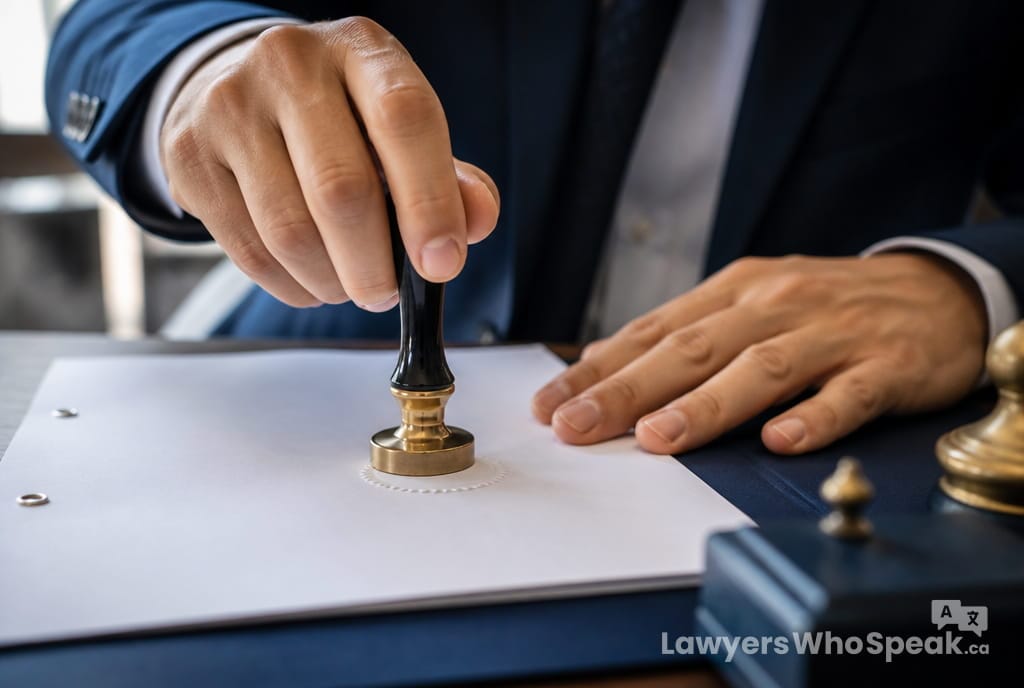
In Ontario and most English-speaking provinces, a notary public is not a separate legal profession in the same way it is in many other countries. In Ontario, notarization is typically performed by lawyers or commissioners of oaths. A notary public in this context is simply someone who is authorized to witness and authenticate signatures on documents, certify copies of documents, and administer oaths and affirmations.
Notarization in Ontario is commonly required for documents being used internationally, such as immigration documents, powers of attorney for use abroad, statutory declarations, and certified true copies of passports or diplomas. The notary is verifying the authenticity of a signature or document, not providing legal advice.
Notaries in Quebec and British Columbia
Quebec and British Columbia are exceptions. In Quebec, notaries are fully trained legal professionals who play a central role in the legal system, handling real estate transactions, wills, marriage contracts, and many other civil law matters. In British Columbia, notaries public are also a regulated profession with a broader scope of practice than in Ontario, handling real estate transactions, wills, and certain estate matters. If you are in Ontario, the most important thing to understand is that a notary public here is not the same as a full-service notary in Quebec, British Columbia, or in many other countries. For most legal matters in Ontario, you will need a lawyer.
What Is a Commissioner of Oaths?
A commissioner of oaths is someone who is authorized to witness and certify sworn statements, affidavits, and statutory declarations. In Ontario, many lawyers and paralegals are commissioners of oaths, but so are some other professionals such as certain government employees. If you need a document sworn or certified for use in Ontario, a commissioner of oaths can usually help. If you need a document certified for use in another country, you will likely need a notary public, and in some cases an apostille or additional authentication may be required.
What Is a Paralegal in Canada?
A paralegal is a licensed legal professional in Ontario who can provide certain legal services independently, without the supervision of a lawyer. Paralegals are regulated by the Law Society of Ontario and can represent clients in specific courts and tribunals.
In Ontario, paralegals are authorized to handle:
- Minor criminal offences and provincial offences, such as traffic tickets
- Small Claims Court matters up to $35,000
- Landlord and Tenant Board hearings
- Ontario Labour Relations Board matters
- Workplace Safety and Insurance Board appeals
- Human Rights Tribunal matters
Paralegals cannot represent you in Superior Court, Family Court, or in most criminal matters involving serious charges. For those situations, you need a lawyer. Paralegals typically charge lower rates than lawyers, which can make them a cost-effective option for the matters they are authorized to handle.

Lawyer vs. Notary vs. Paralegal: A Quick Comparison
Here is a simple breakdown to help you decide who you need:
You likely need a lawyer if you:
- Are facing a criminal charge
- Are going through a divorce, separation, or custody dispute
- Are buying or selling a home
- Are dealing with an immigration matter
- Have been wrongfully dismissed from your job
- Need a will, power of attorney, or estate administration
- Are starting or selling a business
- Are involved in a personal injury claim
You likely need a notary or commissioner of oaths if you:
- Need to certify a copy of a document such as a passport or diploma
- Need to have a signature witnessed and authenticated
- Need to swear an affidavit or statutory declaration
- Need documents certified for use in another country
You may be able to use a paralegal if you:
- Have a traffic ticket or minor provincial offence
- Have a Small Claims Court matter under $35,000
- Have a landlord and tenant dispute
- Have a workplace or human rights tribunal matter
Why This Matters for Newcomers to Canada
Many newcomers to Canada come from countries where notaries play a much broader role in the legal system. In countries with civil law traditions, such as many nations in Latin America, Europe, the Middle East, and Asia, notaries often handle real estate transactions, business registrations, family law matters, and more.
In Ontario, these matters are handled by lawyers, not notaries. If you go to a notary in Ontario expecting the full range of services you may have been used to back home, you may find that they are not authorized to help you with what you need. Additionally, be cautious of anyone who presents themselves as a legal professional but is not a licensed lawyer, paralegal, or authorized notary. Unauthorized practice of law is a serious issue in some communities, where individuals may charge fees to fill out immigration forms or provide legal advice without being licensed to do so. Always verify credentials before paying for legal services. If you discover after hiring that the professional you chose isn’t the right fit, you have the right to change representation. See our guide on how to switch lawyers mid-case.

Finding a Multilingual Lawyer or Legal Professional in Toronto
Once you know what type of legal help you need, the next step is finding the right professional. If you need a lawyer and English is not your first language, finding someone who communicates in your language can make a significant difference in how clearly you understand your situation and how well your interests are represented.
Lawyers Who Speak is Canada’s multilingual legal directory, built to help you find a multilingual lawyer in Toronto and the GTA by language and practice area. Our directory features lawyers who speak Arabic, Mandarin, Punjabi, Spanish, Hindi, Farsi, Cantonese, French, Tamil, and many more languages. Before your first meeting with a lawyer, read our guide to what to expect at your first legal consultation and review our list of questions to ask before hiring a lawyer to make sure you are fully prepared.
The Bottom Line
In Ontario, the roles of lawyers, notaries, and paralegals are distinct. For most serious legal matters, you will need a lawyer. For document certification and authentication, a notary public or commissioner of oaths can help. For certain tribunals and minor matters, a paralegal may be the right and more affordable choice. Understanding who does what is the first step toward getting the right help. If you are unsure, it is always worth reaching out to a licensed lawyer for a consultation to make sure you are on the right path.
Frequently Asked Questions
What is the difference between a lawyer and a notary in Canada?
In Ontario and most English-speaking provinces, a notary public is only authorized to witness signatures, certify documents, and administer oaths. They cannot give legal advice or represent you in court. A lawyer is a fully licensed legal professional who can handle all types of legal matters. In Quebec and British Columbia, notaries have a broader role and can handle real estate, wills, and other matters.
Do I need a lawyer or a notary for a real estate transaction in Ontario?
You need a lawyer. In Ontario, real estate transactions require a licensed lawyer to conduct title searches, register the transfer of ownership, handle mortgage instructions, and close the transaction. A notary public in Ontario does not have the authority to perform these functions.
What can a paralegal do in Ontario?
A paralegal licensed by the Law Society of Ontario can represent clients in Small Claims Court (up to $35,000), the Landlord and Tenant Board, provincial offences court, the Human Rights Tribunal, and certain other tribunals. Paralegals cannot represent clients in Superior Court, Family Court, or in most serious criminal matters. Those require a lawyer.
How do I verify that a lawyer or paralegal is licensed in Ontario?
Visit the Law Society of Ontario’s public directory at lso.ca and search by the person’s name. The directory shows whether they are currently licensed and in good standing. Always verify credentials before paying for any legal services.
Can a commissioner of oaths provide legal advice?
No. A commissioner of oaths is only authorized to witness sworn statements, affidavits, and statutory declarations. They cannot provide legal advice, represent you in legal proceedings, or certify documents for use in other countries. For legal advice, you need a licensed lawyer.
Find a Multilingual Lawyer in Toronto Today
Lawyers Who Speak is Canada’s multilingual legal directory. Search by language, practice area, and location to find a lawyer who can help you clearly and confidently in the language you are most comfortable with. Visit lawyerswhospeak.ca to start your search.
Disclaimer: This article is for informational purposes only and does not constitute legal advice. Please consult a qualified legal professional for advice specific to your situation.